

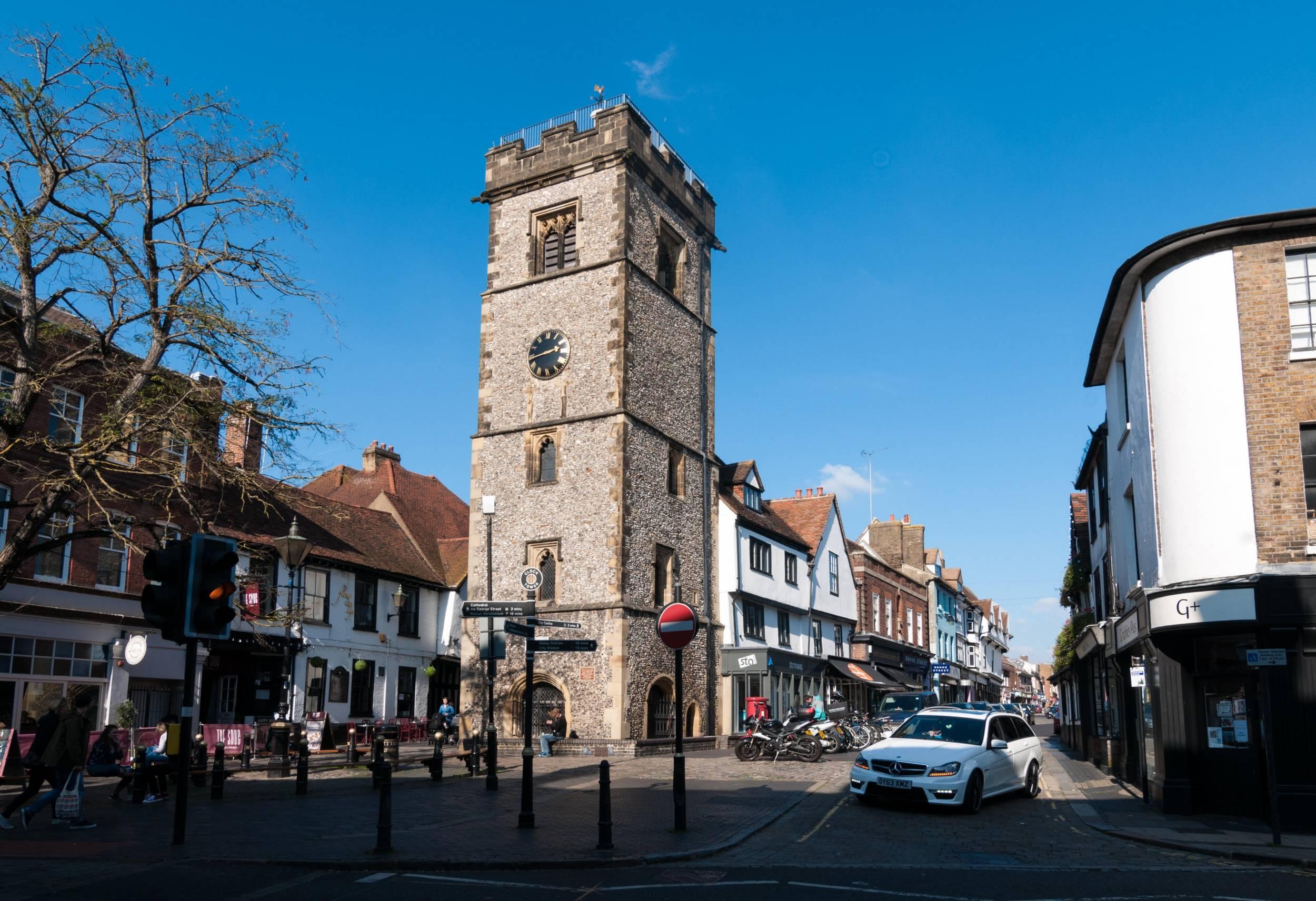
Is St Albans seeing a shift in the balance of power as residents grow increasingly dissatisfied with both local and national politics?
In last May’s county council elections, Reform UK came second in the divisions of St Albans East, North and South and St Stephen’s, beating the Conservatives in each area.
Elsewhere in the country, Nigel Farage’s party has seen its support swell even as grassroots Conservatism struggles to hold onto votes. The mainstream media are heralding Farage as the next Prime Minister, but have faced criticism for the amount of coverage given to his party.
Last September analysis revealed that Reform had featured in a quarter of all News At Ten bulletins over a six month period, and on three times as many ITV News bulletins as the Liberal Democrats, despite being the UK’s third largest party.
However, the party’s inability to win the by-election in Gorton and Denton, despite waging a fierce campaign for the constituency, suggests that perhaps there are more people actually opposing their policies than pledging their support.
So what narrative should we believe?
Here, Reform activists claim rising council tax, pressure on services and ongoing developments are leaving residents feeling disconnected and unheard. They say it isn’t just about national politics, it’s about the day-to-day realities of potholes on their streets, parking costs, school places, and whether their children will ever be able to afford to live locally.
Membership of the St Albans branch of Reform has apparently been growing substantially over the past year, with numbers more than tripling. They attribute this to ordinary people looking for a more honest and practical approach to politics, rather than the protest voting and extremism attributed to the party elsewhere in the UK.

So why did these local people decide to start supporting Reform? Eleanor Jackson, the interim branch chair of Reform St Albans, explained her own reasons: “I decided to support Reform UK after more than a decade of Conservative failure. They were conservative in name only and repeatedly failed to deliver on the promises they made.
“I worked hard to buy my first home at the age of 23 and came close to losing it just two years later when interest rates doubled following economic mismanagement. Despite doing everything ‘right’, working full-time and studying part-time to avoid student debt, it became clear that hard work was no longer being properly rewarded.
“Immigration is also an important issue for me – not because immigration itself is wrong, but because when it is poorly planned and poorly managed, it places pressure on housing, healthcare, infrastructure and local services, leaving communities feeling the strain.
“Ultimately, I no longer felt represented by the existing parties. Reform UK offered something different: honesty about long-standing problems, a willingness to challenge failure, and a focus on putting ordinary working people back at the centre of politics.
“I didn’t get involved because I wanted a political career – I got involved because I care about my country and the city where I live.”
Many other members of Reform UK St Albans describe similar journeys – supporting different parties in the past, only to feel repeatedly let down.
Marc Levine said: “We can’t keep repeating the same mistakes of Labour and faux Tory administrations with little difference between them.”
Jim Humphrey said he had supported the Conservative Party for years, but noted: “Over time I found that the Conservatives no longer represented my values and constantly reneged on their manifesto promises.”
Ben Harris puts it simply: “The uni-parties are more concerned about themselves, rather than delivering what is best for the country.”
He is referring to the theory that the Conservatives and Labour now function in practice as a single entity despite appearing to be opponents, with a unified set of political, economic, and social interests, collaborating behind the scenes and offering voters no real alternative.
Others describe a longer arc of frustration with the political system as a whole, with one member who asked to remain anonymous stating: “Our population has grown by 10 million since 1997, underpinning many of today’s problems: high rents and house prices, NHS waiting lists, ballooning benefits spending, and crumbling roads and infrastructure. It took me 14 years to work out it was a falsehood… proving the Tories were Liberal Democrats in all but name.”
For Dianna Knight, Reform UK bought a sense of camaraderie: “I’ve decided to support Reform because they offer more of a sense of belonging, a common-sense approach, and have a connection with the ordinary person on the street.”
What is striking about the St Albans branch is that members come from very different backgrounds — former Labour voters, former Conservatives, people who had stopped voting altogether, small business owners, professionals, and retirees. They say what unites them is a clear sense that the traditional two-party system no longer offers meaningful choice.

When asked what they thought the most important issues were in St Albans and what they would like local government to do better the same concerns arose again and again.
One of the strongest frustrations is how council money is being spent, with residents working hard but paying rising council tax bills year after year. They say they increasingly feel they are getting less in return.
“Too often, money appears to be directed towards vanity projects or poorly judged initiatives, whilst core services continue to deteriorate,” said one member.
Marc Levine says: “The roads in Hertfordshire are in a dreadful state… the county council only fix 31 per cent of faults reported. This is unacceptable.”
Alan Haigh agrees: “Currently the condition of roads, pavements, trees, shrubs and hedges all display severe neglect with council tax being in most cases the highest monthly outgoing.”
Eleanor adds: “When costly mistakes are made, accountability is often lacking – which only deepens public frustration.”
Preserving the historic character of St Albans is another major concern. Members say they want development that is genuinely sustainable and properly planned, not the current system with schemes driven primarily by developers, and infrastructure seemingly added as an afterthought.
They agree that protecting the Green Belt is not about opposing housing altogether, but about ensuring growth reflects real local demand and does not permanently damage the environment and heritage that make St Albans such a special place to live.”
Dianna expressed a growing frustration that the district council “relentlessly agrees to build unnecessarily on Green Belt land”.
Housing affordability sits at the heart of this issue. Many families are increasingly worried that their children will have little chance of staying in the city they grew up in.
On this topic, one member says: “It’s a tragedy that our young have next to no hope of getting on the housing ladder.”
At the same time, members do not want uncontrolled expansion that risks merging St Albans into the surrounding areas of Borehamwood, Watford, and Hemel Hempstead, a balance they say has been missing from local developments.
Most members of Reform UK St Albans don’t oppose development in principle – but they say they want it done in a way that protects communities and gives local young people a fair chance.

Public safety is another concern raised repeatedly. The branch put in an FOI request in to Hertfordshire Constabulary to obtain the percentage of successful charge rates for sexual offences and violent crimes in St Albans, with most figures coming back as being in the low single digits.
Eleanor adds: “Many residents feel visible policing has declined. Paying more council tax whilst feeling less safe is simply not acceptable.”
For many St Albans members, politics isn’t just an abstract debate — it directly affects their ability to make a living. Local pubs, shops and cafés are not just businesses in our city, town and villages – they are the places where neighbours meet, friendships are formed, and community life happens. But many businesses, particularly in hospitality, are under immense pressure from rising costs and regulation.
Michael Axford, a local pub landlord says: “If my pub is forced to close, I will lose everything I have worked for and invested in over almost two decades.
“Unaffordable energy costs and new Labour policies have pushed small businesses like mine into debt and made survival incredibly difficult.
“I want to protect my livelihood, my staff, and a community pub that means everything to local people.”
Reform members say they want value for money, transparency, and common sense, with decisions made in partnership with residents, not imposed upon them.
So why do they think Reform UK is resonating locally? The general consensus was that although St Albans is often described as affluent and therefore often insulated from national problems, it has become increasingly difficult to ignore the scale of failure that has built up over recent decades.
Marc Levine says: “We are sick of the same status quo offered by the existing parties.”
Fred adds that Reform is a beacon for some: “HOPE is my reason to support Reform.”
Another member says: “I think people are fed up. They pay their council tax, and what do they get for their money? Add in the ever-increasing parking charges; whilst spending money on cycle lanes and 20mph speed limits, it feels like an attack on ordinary working citizens.”
For many of these members, they say Reform’s appeal lies in its focus on practical solutions, transparency, and common sense, but they remain acutely aware of what they perceive as misconceptions surrounding the party.
Marc says: “The main parties and mainstream media are terrified of a Reform victory, so they paint us as far right.”
Ken Pinder continues: “Our adversaries spread untruths about our leaders and some of these may stick in peoples’ minds.”
When asked why these labels may persist Eleanor says: “The definition of what is considered ‘extreme’ has shifted significantly in recent years. Views that were mainstream a decade ago – wanting secure borders, safe streets, and accountable Government – are now routinely described as radical. Reform UK is not fringe – the political centre has moved to the left.”
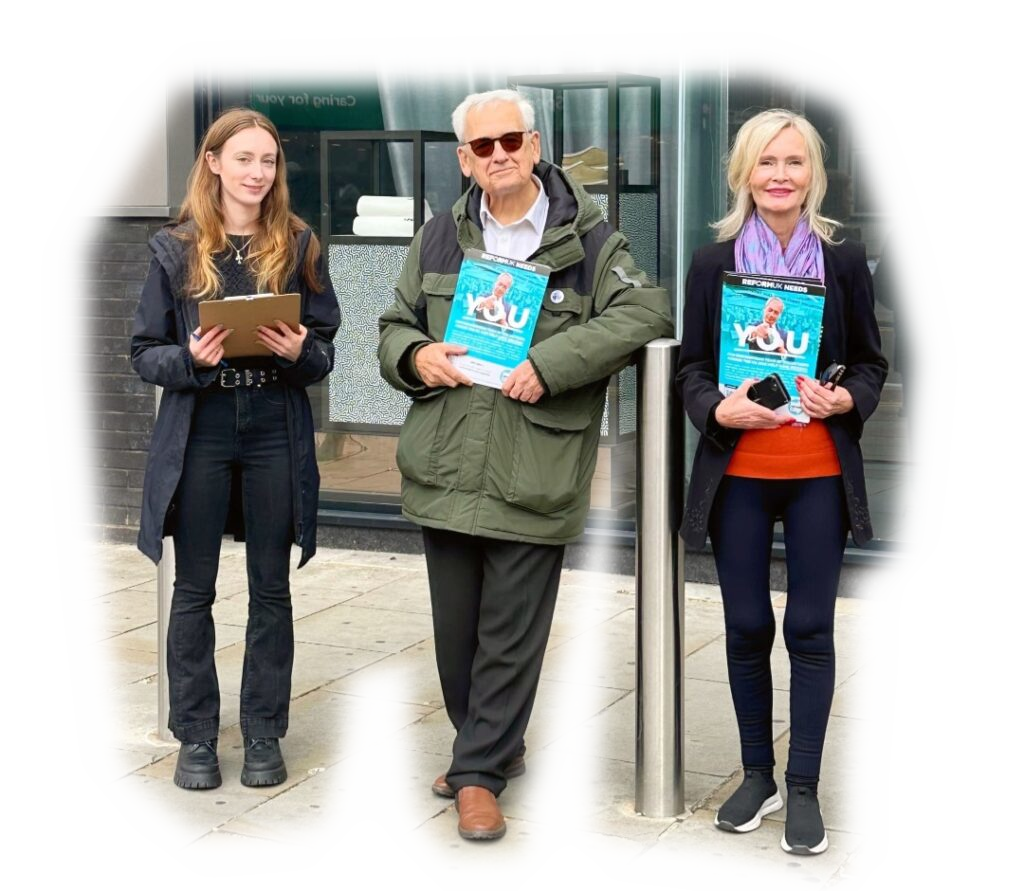
During a Reform action day in St Albans last November, the branch experienced first-hand how deep some of these misconceptions play out. While many residents were polite or simply disinterested, members said others reacted with hostility.
Supporters handing out leaflets in the city centre were called racist, had profanities shouted at them, and one member had a leaflet snatched from her hand before being torn in half and thrown on the pavement.
In a separate incident the previous year, an elderly Reform supporter was chased down the street and branded a “Nazi” simply for delivering literature.
Branch members say these reactions, while upsetting, underline why they believe it is important to challenge false narratives about the party – and to keep engaging with residents respectfully, even when that engagement can be difficult.

Do they think the recent defections to the party by ex-Conservatives will result in Reform becoming the Tory party 2.0?
Stewart Vassie doesn’t think so: “Because Reform is a new party, in effect, all supporters and members are ‘defectors’ in a way. Experienced politicians are an asset. A party needs to campaign well, raise funds and eventually govern well too.”
Eleanor adds: “Reform UK is not a refuge for failed Conservatives – but if we want to govern competently in the future, we must value experience. Drawing on people who have held senior roles before does not mean repeating their old mistakes – it means learning from them and doing things differently.”
When asked about whether the presence of controversial leader Nigel Farage was positive or negative for the party, Stewart says: “Nigel brings visibility, communication skills and international recognition that a new party would otherwise struggle to achieve. Whilst not everyone likes him, he cuts through the noise and ensures Reform UK is part of the national conversation.”
So does he think Farage’s relationship with US President Donald Trump is a cause for concern? “Having a working relationship with figures like Donald Trump may be controversial to some, but maintaining good working relations with the most powerful country in the world is simply pragmatic.”
Eleanor says: “Nigel Farage is, like most things in politics, polarising – but that is largely because he says out loud what many people have been thinking for decades. He came out of retirement to put this country first, and he speaks a kind of common sense that many politicians are afraid of.
“On Donald Trump, people may not like him personally, but he is fiscally conservative in a way that has already delivered tangible benefits for Americans – from easing housing pressures to taking border security seriously. A constructive
relationship with the United States is essential for Britain if we want options, leverage and the ability to learn from what works elsewhere.
“Right now, Keir Starmer risks damaging that relationship, and ultimately that will be to the detriment of the British people. Whatever your view of Trump, it is in our national interest to have a strong relationship with what is, arguably, the world’s most influential country.”
Whether people like Nigel Farage or Donald Trump personally, the view of local Reform members is that politics should be judged on outcomes, not personalities, and they say they are approaching the May elections with a growing confidence.
Eleanor adds: “We are not career politicians. We are residents with an array of different backgrounds who want a local government that listens, spends responsibly, and puts community first.
“Whether someone has voted all their life or hasn’t voted in years, our message is simple: Your voice matters again – and we are here to listen.”

Comments